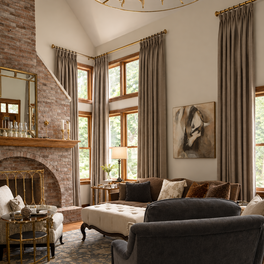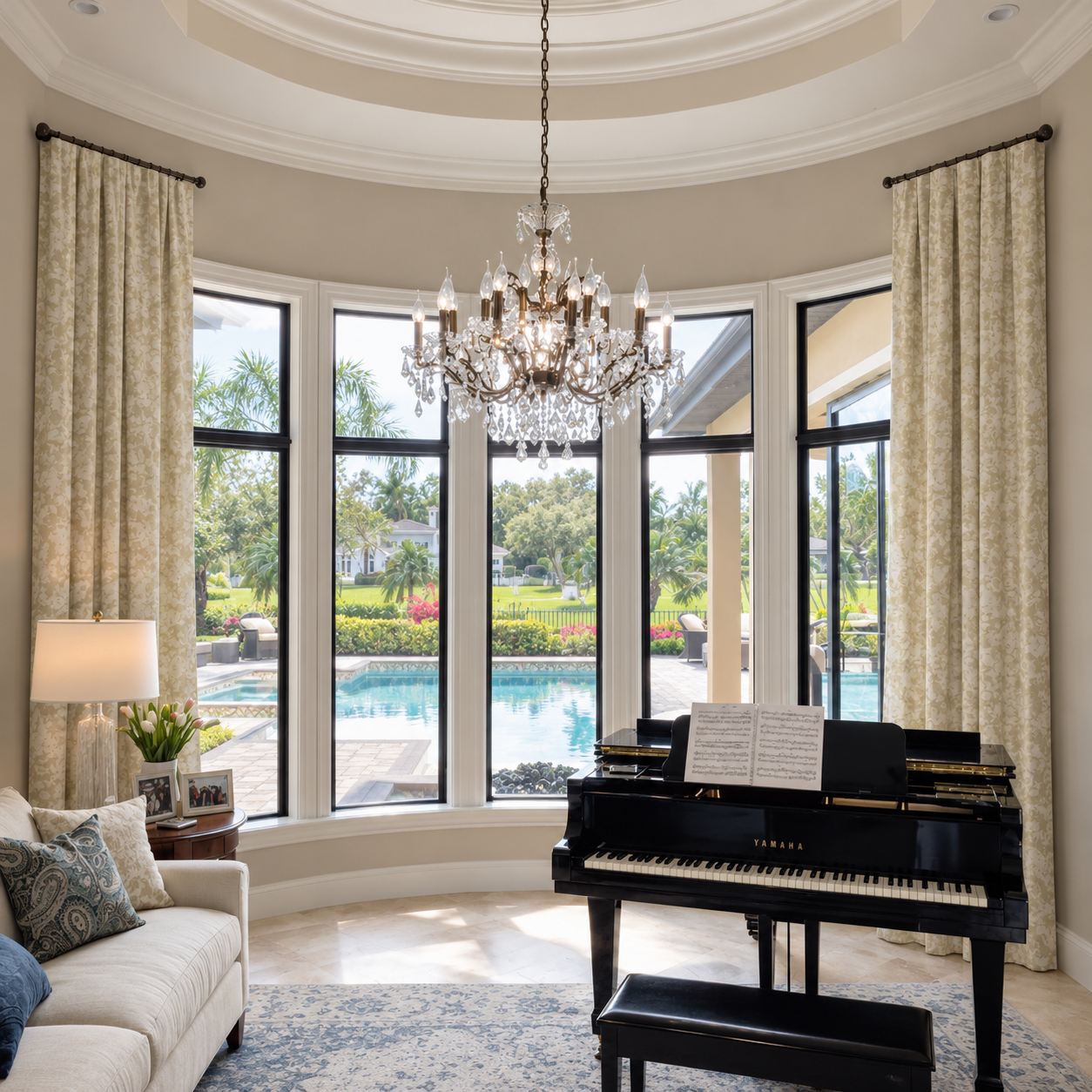
The placement of your drapery rod can make your window look wider and your room feel taller. The goal is to give your drapes enough room to open, choose a height that looks balanced in your space, and support the rod with the right brackets.
Quick guide
| Rod width | 8 inches past the outside edge of the trim on each side. A 36-inch window gets a 52-inch rod, plus finials. |
| Standard height | Top of the rod 6 inches above the trim. |
| Taller look | Halfway to two-thirds of the way from the trim to the ceiling, or just below the ceiling or crown molding. |
| End brackets | 2 to 3 inches in from each end of the rod, with one ring outside each bracket. |
| Center support | For a pair of drapes on rings, one support in the middle, where the panels meet. |
| Wide windows | A traverse rod or track, with a bracket about every 24 inches. |
How far should the rod extend beyond the window?
Whenever possible, extend the rod 8 inches past the outside edge of the window trim on each side.
For example, a 36-inch-wide window would have a 52-inch-wide rod, excluding the decorative ends, called finials.
This extra space allows the open drapes to rest beside the window, letting in more light and making the window look wider. Wide drapes or those made with fuller fabrics may need more space to open fully.
If a nearby wall or another window limits your space, reduce the extension on that side. Small finials or simple end caps can help you make the most of the available room.
How high should you hang a curtain rod?
For a standard placement, position the top of the rod about 6 inches above the window trim.
To make the room feel taller, place the rod higher. If there is a large gap between the window and ceiling, try placing it halfway to two-thirds of the way up that space.
For example, if there are 18 inches between the window trim and ceiling, placing the rod 9 to 12 inches above the trim is a good option.
For a look that draws the eye all the way up, place the rod near the ceiling or just below the crown molding. Leave enough room for the brackets and hardware.
These are options, not rules you need to follow together. Start with the standard placement, then go higher if it suits your room.
Where do the brackets go?
Brackets hold the rod to the wall. Where you place them affects how the drapes open and how well the rod carries their weight.
- End brackets: about 2 to 3 inches in from each end of the rod, before the finials. With an 8-inch extension, this puts them on the wall just outside the window trim.
- Anchor ring: place one ring between each end bracket and its finial. It holds the outer edge of the drape at the end of the rod, so the panel stays in place when you open and close it.
- Center support: for a pair of drapes, add a bracket in the middle of the rod, where the two panels meet. It keeps the rod from bending under the weight of the fabric.
- Solid mounting: screw brackets into wall studs where you can, or use wall anchors rated for the weight. Lined, interlined, and blackout drapes are heavier and put more load on each bracket.
Do you need a center support?
A center support keeps a long rod from sagging. Whether you can use one depends on the rings.
Drapery rings wrap all the way around the rod, so they cannot slide past a bracket. That decides where the supports can go:
- A pair of drapes (opens from the center): 3 brackets, one at each end and one in the middle. Each panel's rings stay on their own side, so the center support never gets in the way.
- A single panel (opens to one side): 2 end brackets only. A center support would stop the rings, so the rod relies on the end brackets alone.
For a wide window, choose a traverse rod or a track. These use carriers instead of rings, and the carriers ride past the brackets, so the rod can be supported about every 24 inches across any width. They also glide more smoothly under heavy, lined drapery, and they can be motorized.
How many brackets does your rod need?
| Hardware | Rod width (without finials) | Brackets |
|---|---|---|
| Rod with rings, single panel | Any width the rod allows | 2 |
| Rod with rings, pair | Any width the rod allows | 3 |
| Traverse rod or track | Up to 48 inches | 2 |
| Traverse rod or track | 49 to 72 inches | 3 |
| Traverse rod or track | 73 to 96 inches | 4 |
| Traverse rod or track | 97 to 120 inches | 5 |
| Traverse rod or track | 121 to 144 inches | 6 |
You don't need to work this out yourself. When you choose hardware in the Regal Drapes design tool, your order includes the right number of brackets for your rod width and hardware, and the tool lets you know if the hardware you picked can't support your rod width.
A note about C-rings
You may see C-rings, also called bypass rings, suggested as a way to add more supports to a rod with rings. Each ring has an opening on the back so it can slide past special bypass brackets. They are a workaround, not a custom solution, and we don't recommend them for custom drapery:
- They can catch. Every ring has to face exactly the right way to clear the bracket. A ring that turns slightly can snag, and even hardware specialists note that bypass rings and brackets aren't always easy to operate.
- Every part has to match. The rings, bypass brackets, and rod must come from the same manufacturer and collection. Mixing parts usually doesn't work, and they generally can't be added to an existing rod later.
- They aren't built for heavy drapery used every day. Lined, interlined, and blackout panels that open and close daily need hardware made to carry the weight and glide smoothly. That is the job of a traverse rod or track.
For a wide window, a heavy fabric, or drapes you'll use every day, choose a traverse rod or a track. Not sure which? Talk to a designer.
Check the placement before installing
Mark the proposed rod height, rod ends, and bracket positions with painter’s tape, then step back and look at the whole wall.
Check that:
- The rod has room for its brackets and finials.
- The drapes will have space beside the window when open.
- The brackets land on solid wall, not on the edge of the trim.
- The height looks balanced with the ceiling and nearby windows.
For windows next to each other, keeping the rods at the same height usually creates a more consistent look.
What if you are using a track?
The same design principles apply: extending the track beyond the window gives the drapes room to open, and placing it higher can make the room feel taller.
A wall-mounted track can sit above the window. A ceiling-mounted track creates a floor-to-ceiling look. Your choice depends on the style you want and where the hardware can be installed. Either way, plan on a bracket about every 24 inches.
Choosing hardware for your wall space
Once you know where the rod goes, choose the hardware in the Regal Drapes design tool:
- Limited wall space: choose smaller finials or end caps. They save room, so the rod can be wider and the drapes have more space to stack back.
- Plenty of wall space: choose larger, more decorative finials as a design feature.
Using the Regal Drapes design tool
The Regal Drapes design tool starts with a rod placed 6 inches above the window and extending 8 inches on each side.
You can change the rod width and height to match your preferred placement. We size your custom drapes to those selections and include the brackets your rod needs.
Need help choosing the placement?
Our designers can review your space and help you choose a rod or track position that works for your windows. For step-by-step instructions, see our measuring and installation guides.
Frequently asked questions
How wide should a drapery rod be?
About 8 inches past the outside edge of the window trim on each side, so a 36-inch window gets a 52-inch rod plus finials. Some designers use as little as 3 to 6 inches, but a wider rod lets the drapes clear the glass and makes the window look wider. If wall space is limited, use a shorter rod with end caps and the design tool will adjust the drapes to fit.
How high should I hang the rod?
Start with the top of the rod about 6 inches above the window trim. For a taller look, place it halfway to two-thirds of the way between the trim and the ceiling, or just below the ceiling or crown molding, leaving room for the brackets.
Does hanging drapes higher make a room look bigger?
Yes. A higher rod draws the eye upward, which makes the window and the ceiling look taller. Extending the rod past the window makes the window look wider as well.
What is stackback?
Stackback is the space the drapes take up when they are open. Mounting the rod wider than the window lets the panels rest on the wall instead of covering the glass. Fuller and heavier drapes need more stackback.
How many brackets does a curtain rod need?
A pair of drapes on rings uses 3 brackets: one at each end and a center support. A single panel on rings uses 2 end brackets. Traverse rods and tracks need a bracket about every 24 inches.
Where should curtain rod brackets go?
About 2 to 3 inches in from each end of the rod, with one ring outside each end bracket to hold the outer edge of the drape. For a pair of drapes, add a center support where the panels meet.
Why can't a single-panel rod have a center support?
Drapery rings wrap all the way around the rod and can't slide past a bracket, so a center support would stop a one-way panel from opening. If the window is too wide for 2 brackets, use a traverse rod or track, which can be supported along its whole length.
Can I change the rod width and height in the design tool?
Yes. Enter your own rod width and height and the tool will recalculate the best panel size for the style you choose.
Can a designer help me decide?
Yes. Our design team can review your space and recommend placement and hardware, and every order is backed by our 100% satisfaction guarantee.
Next step
Ready to see how your drapes will look? Start designing your drapes with the Regal Drapes design tool, or talk to a designer for help with your space.