
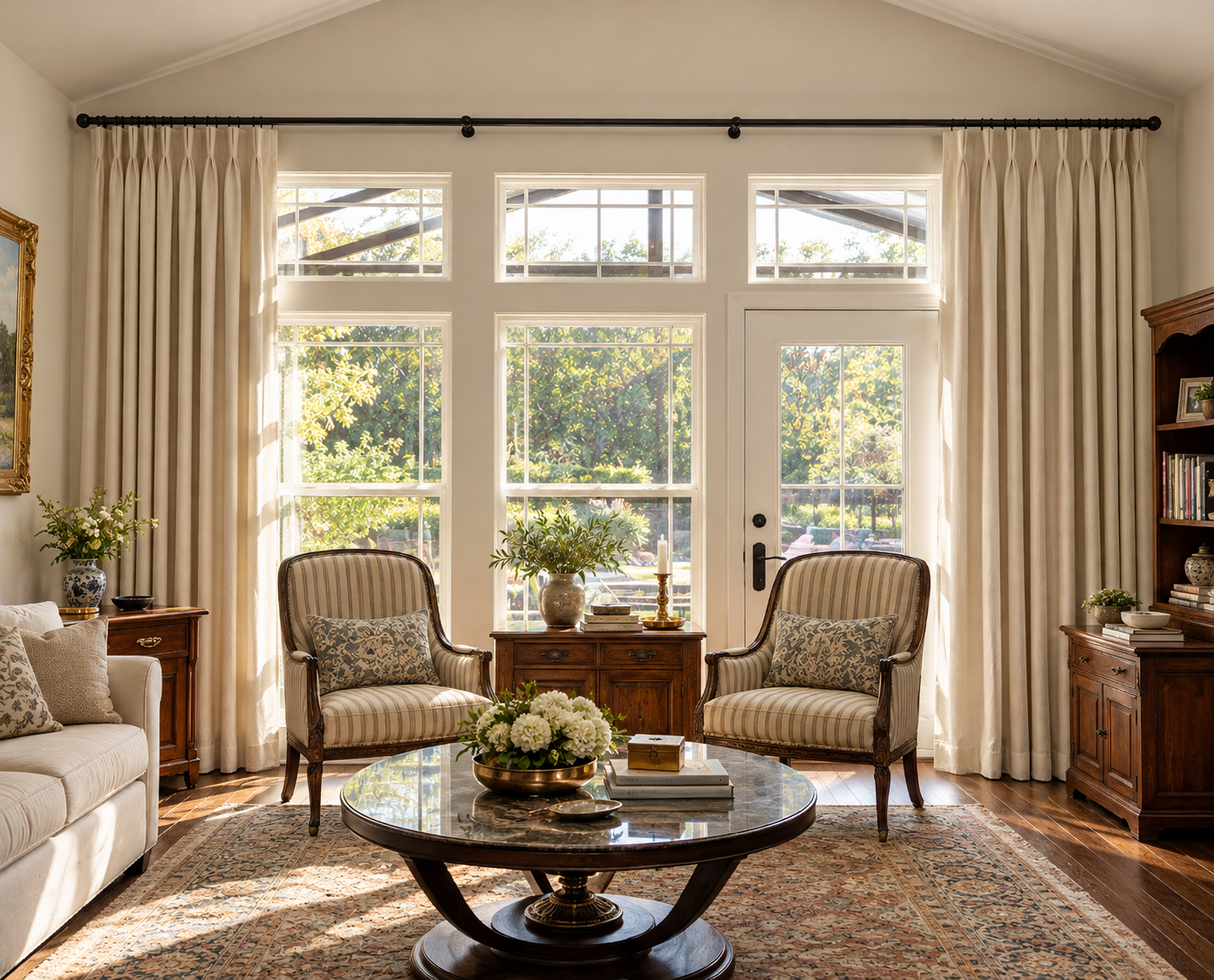
If you have large windows, you may have already tried this: you find curtains you like, check the measurements, and realize they are too short, too narrow, or would require several panels on each side.
You put thought into your furniture, flooring, and paint colors. Your drapes deserve the same attention. They are the finishing touch that brings everything together. Curtains that are too short, lack fullness, or hang poorly can make an otherwise beautiful room feel unfinished.
Ready-made curtains can work beautifully when the available sizes suit your room. Custom drapes give you more control over the dimensions, fabric, lining, and style—especially useful for tall or wide windows.
Here is how to compare the options and choose what works best for your home.
What Is the Difference Between Custom and Ready-Made Curtains?
Ready-made curtains are finished panels sold in standard sizes. Custom drapes are made to your measurements, with your choice of fabric, heading style, and lining.
"Store-bought curtains" and "ready-made panels" generally describe the same thing, whether you buy them online or in a store.
With ready-made curtains, you choose from the sizes and combinations available. With custom drapes, those choices are planned around your home.
Both can be attractive and well made. The difference is how much flexibility you need to achieve the result you want.
Why Large Windows Need More Planning
On a large window, you need to consider more than whether the curtains reach the floor.
Will they close for privacy? Will they stay open to frame the view? Where will the fabric sit when you pull them back?
These decisions affect the width of the drapes, your hardware, and where it should be installed.
Enough fullness to look balanced
Drapes that close need enough fabric to cover the opening while keeping their folds. A panel that barely covers the glass when pulled flat may look skimpy when closed.
Decorative side panels also need enough fullness to look proportional to the window. Narrow panels can look lost beside a large expanse of glass.
When comparing products, check whether the listed width is for one panel or a pair, and whether it refers to flat fabric or the finished pleated width.
Room for the drapes when open
Open drapes still take up space. This gathered fabric is called the stackback.
Substantial fabrics, additional lining, and fuller styles generally need more space beside the window. Allowing for that space helps preserve your view and lets more daylight into the room.
The available wall space matters, too. Custom sizing helps you plan around it, but does not eliminate the space the fabric needs.
The right rod or track
Choose your hardware placement before finalizing the drapery dimensions. That lets you plan the height and width around what looks best in the room.
Our guide to how high and wide to hang your curtain rod explains how placement affects the proportions of the window and the space available for open drapes.
Large drapes can also be heavy. Make sure the rod or track can support the selected fabric and lining and allows the panels to move easily.
When Ready-Made Curtains Work—and Where They Can Fall Short
Ready-made curtains can be a practical choice when you find a fabric, size, and style that suit your room. In-stock panels may be available quickly, and their starting price is usually lower than custom.
Some retailers offer quality fabrics, lined panels, and longer lengths. It is worth comparing the actual products rather than assuming all ready-made curtains are alike.
The difficulty comes when the available dimensions do not match your plans.
You might lower the rod to accommodate a shorter panel, combine several narrow panels across a wide window, or settle for a fabric that is close to what you wanted.
Several separate panels can create visible breaks and may be awkward to open and close. A limited choice of lengths may keep you from mounting the rod at the height you prefer. Hemming can solve a panel that is too long, but it adds another step and cost.
For large windows, the question is whether the available panels give you the proportions, coverage, and operation you want.
What Custom Drapes Do Differently
Custom drapes allow you to plan the finished look and make the panels to suit it.
You can place the rod or track where it looks best, then determine the drapery dimensions. You can choose the fullness that suits the fabric and style and plan where the panels will sit when open.
That flexibility also helps when you have several windows with different dimensions. The treatments can be designed together so the room feels consistent.
At Regal Drapes, we handcraft our window treatments in our Morristown, New Jersey workroom. Our design team helps you consider fabric, lining, measurements, and hardware together, so each choice supports the finished result.
Choose Fabric for the Whole Room
A large window uses a substantial amount of fabric, so your choice has a real effect on the room.
Linen adds texture and a relaxed feel. Velvet brings depth and richness. Sheers soften daylight and create an airy finish, although they may not provide enough privacy on their own, particularly at night.
Think about how you want the room to feel and how you use it. A bedroom may need privacy and stronger light control. In a living room, you may want to soften the windows while keeping the view open.
Before deciding, order complimentary fabric samples. Compare them near the window, beside your wall color, and against your furniture. Check them in daylight and again with your lamps on in the evening.
The right fabric should work with everything you already love about the room.
What Lining Do You Need?
Lining affects more than how much light comes through. It also influences how the drapes hang and helps protect the face fabric from sunlight.
Your choice depends on the room:
- Privacy lining filters light and adds body for everyday use.
- Thermal Dim-Out lining offers stronger light control and an additional insulating layer without full blackout.
- Blackout lining is useful in bedrooms and other spaces where darkness matters.
- Interlining, an extra layer between the fabric and lining, adds body and a fuller drape.
Blackout lining blocks light through the fabric, but light can still enter around the sides, top, and center opening. Coverage and hardware placement matter, too.
Our guide to drapery linings and interlining explains how the options affect light, comfort, and the way your drapes hang.
With ready-made curtains, lining choices depend on the product. Custom drapes offer more flexibility to select a suitable combination for your fabric and room.
Which Style Looks Best on Large Windows?
The best style depends on your room, the fabric, and how you want the drapes to operate.
Pinch pleats have a classic, tailored appearance that works in traditional and transitional rooms.
Tailored pleats create a clean, structured finish.
Ripple Fold drapes hang in soft, even waves along a compatible track. They work well across wide windows and suit a modern look.
Goblet pleats add a decorative detail suited to a more formal room.
The same style can look relaxed in linen or more substantial in velvet. Choosing the fabric and heading together helps create the balance you want.
For wide or hard-to-reach windows, consider how you will open and close the drapes. A suitable track or motorized system can make daily use easier.
Compare the Complete Cost
Ready-made curtains usually have a lower purchase price. Custom drapes generally cost more because they are made for your project.
To compare fairly, include everything needed for the finished installation:
| Cost to consider | What to check |
|---|---|
| Panels | The total number needed for coverage and fullness |
| Lining | Whether your preferred option is included |
| Alterations | Hemming or other adjustments |
| Hardware | Rod or track, brackets, rings, and accessories |
| Services | Measuring and installation |
| Delivery | Shipping and any additional fees |
Ready-made curtains may be the right value when their dimensions and options already suit your room.
Custom drapes are worth considering when getting the look you want would otherwise mean extra panels, alterations, or compromises you will notice every day.
Which Option Is Right for Your Windows?
Choose ready-made curtains when you find the right size, fullness, fabric, and lining in an available product. Choose custom drapes when you want more control over those details.
For large windows, start with how the drapes will function and where the hardware should go. Then compare the options against that plan.
You do not need to have every detail figured out before asking for help.
Get Help Bringing It Together
Large windows do not need complicated window treatments, but they do benefit from careful planning.
At Regal Drapes, our complimentary design service can help you choose fabrics, compare styles, and work through measurements and hardware placement. Professional measuring and installation are also available; ask about availability and pricing for your project.
Whether you are furnishing one room or your whole home, we can help you create drapes that bring everything together.