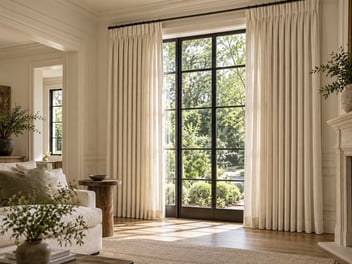
Cozy winter room with custom drapes in Thermal Dim-Out Lining, which helps keep the room warmer in winter and cooler in summer.
The layers behind your drapery shape how it looks, how it hangs, how long it lasts, and how comfortable your room feels in every season.
Most people choose drapery for the fabric they can see. But what sits behind that fabric matters just as much. Linings decide how much light comes through, how the drapery falls, how well the face fabric holds up in the sun, and how well the window holds heat in winter and keeps it out in summer.
Regal Drapes offers five linings, plus unlined drapery. Premium Privacy is our standard lining. Choose Thermal Dim-Out for insulation with softened light, Black-Out to block 99% of light, and add interlining to Premium Privacy or Black-Out for silk and a fuller, more luxurious drape.
Drapery linings compared
| Lining | Light | Thermal insulation | Noise insulation | Best for |
|---|---|---|---|---|
| No Lining | Lets light through | Minimal | Minimal | Sheers and casual linens |
| Premium Privacy (standard) | Filters light, adds privacy | Basic | Basic | Most rooms |
| Thermal Dim-Out | Blocks about 70% | Moderate to significant | Moderate | Living rooms and street-facing rooms that need insulation and privacy without full darkness |
| Black-Out | Blocks 99% | Moderate to significant | Moderate | Bedrooms, nurseries and media rooms |
| Premium Privacy with Interlining | Reduces incoming sunlight | Moderate | Moderate | Silk, lighter fabrics and formal rooms |
| Black-Out with Interlining | Blocks 99% | Moderate | Moderate to significant | Bedrooms that need darkness, quiet and a full, rich drape |
Light, insulation and noise ratings are from our lining specifications. "Basic" and "Minimal" are general guidance for linings without a stated rating.
Why lining quality matters
A lining isn't just a backing. It makes up half of every panel you hang, and its quality shows in how the drapery looks, moves and performs. That's why our standard lining is a heavy-weight, 100% cotton sateen rather than the thin, lightweight linings often found in ready-made curtains.
- Hand: cotton has a soft, supple hand. It moves with the face fabric instead of fighting it, so pleats fall into even, natural folds rather than stiff, flat ones.
- Drape: a heavier cotton lining adds body without stiffness. Panels hang straight, stack neatly when open and keep their shape over the years.
- Color: our linings come in a white finish. A clean white lining doesn't tint the light coming into the room or shadow through lighter face fabrics, and it gives every window the same tidy look from the street.
- Light control: a dense, tightly woven lining blocks more light and evens out the glow through the face fabric, so stitching, hems and bright spots stay hidden when the sun is behind the drapes.
- Temperature and energy savings: windows are one of the biggest sources of heat loss in winter and heat gain in summer. Every layer between the glass and the room slows that exchange. A quality lining is the first layer, and Thermal Dim-Out, Black-Out and interlining add more, helping keep rooms warmer in winter and cooler in summer, which can reduce heating and cooling costs.
- Longer life: the lining shields the face fabric from the sun, so colors fade less and the drapery looks new for longer.
More than looks: a room that's comfortable to live in
The right lining makes a big difference in how drapery looks. But its biggest payoff is how the room feels to live in, day and night, in every season.
- A comfortable temperature: lined drapery slows the heat escaping through the glass on winter nights and blocks the sun's heat on summer afternoons. The room stays closer to the temperature you set, and the chill you feel sitting near a window eases.
- Softer, glare-free light: a lining diffuses harsh sun, cuts glare on TV and computer screens, and keeps bright patches off floors and furniture.
- Privacy after dark: with the lights on at night, unlined drapery can show what's happening inside. A lined panel keeps the room private.
- A calmer, quieter room: denser linings and interlining absorb sound and reduce echo, so the room feels calmer and more relaxing.
- Better sleep: in bedrooms, Black-Out Lining keeps the room dark from bedtime until you're ready to wake up. More on that below.
No Lining (unlined drapery)
Unlined drapery is light and airy, letting soft, filtered light into the room. It suits sheers and casual linens beautifully. The trade-off is less privacy, less structure, and more sun exposure for the fabric itself.
Premium Privacy Lining: our standard lining
Premium Privacy is the standard lining for all Regal Drapes drapery: a heavy-weight, 100% cotton sateen with a softened lustre finish.
- Gives drapery more body and fullness, so it hangs evenly.
- Offers moderate protection from sunlight damage for the face fabric.
- Is crease, water and stain resistant.
- Comes in a white finish, so your windows look clean and consistent from outside.
For most rooms, it's the right starting point.
Thermal Dim-Out Lining
Thermal Dim-Out gives you the insulation of a blackout lining without making the room completely dark. It is a 50/50 poly-cotton blend.
- Blocks about 70% of light.
- Provides moderate to significant thermal insulation, helping keep heat in during the cool months and out in summer.
- Provides moderate noise insulation.
It's a good choice for living rooms, home offices and street-facing rooms where you want privacy and comfort but still want daylight.
Black-Out Lining
Black-Out Lining is a foam-coated, 100% polyester base cloth that keeps light from coming through the window.
- Blocks 99% of light.
- Provides moderate to significant thermal insulation.
- Provides moderate noise insulation.
It's ideal for bedrooms, nurseries and media rooms. For the darkest result, mount the rod outside the window frame and extend it past the window on each side, so light can't slip around the edges. Our guide to where to put drapery hardware shows how far to extend it.
Blackout lining helps you sleep better
Light is one of the strongest signals your body uses to know when it's time to wake up. Streetlights, passing headlights and early summer sunrises can cut a night's sleep short. Because Black-Out Lining blocks 99% of light, the bedroom stays dark until you're ready to get up, which makes it easier to fall asleep, stay asleep and sleep in on weekends.
It makes the biggest difference in:
- Nurseries and children's rooms, for naps and early bedtimes.
- Bedrooms that face east or a lit street.
- Homes with shift workers who sleep during the day.
For a bedroom that is dark, quiet and warm, choose Black-Out Lining with Interlining.
Interlining
Interlining is a soft cotton flannel layer sewn between the face fabric and the lining. You never see it, but you notice it right away: interlined drapery hangs in fuller, rounder folds and feels more substantial in the hand.
What interlining does
- Fuller, softer folds: the extra body turns flat pleats into deep, rounded ones, so even lightweight fabrics look rich.
- Protection for delicate fabrics: it gives significant protection against sunlight damage and supports silk and other fine face fabrics, so they hang better and hold their shape over time.
- Warmth: the added layer helps insulate the window, which is welcome in bedrooms and in older homes with drafty windows.
- A quieter room: thicker panels help soften sound and reduce echoes.
Our interlining options
- Premium Privacy Lining with Interlining: our standard cotton sateen lining with a 100% cotton flannel interlining. It reduces incoming sunlight and is our recommendation for all silk drapery and lighter fabrics.
- Black-Out Lining with Interlining: our Black-Out Lining with the same cotton flannel interlining. It blocks 99% of light and adds moderate to significant noise insulation, for rooms that need full darkness and a rich, full drape.
Is interlining worth it?
For silk, lightweight fabrics and formal rooms, yes. Interlining is what gives custom drapery its full, luxurious fall. It is especially worth choosing for:
- Silk and other delicate or lightweight face fabrics.
- Formal rooms and tall windows, where full, rounded folds make the design.
- Bedrooms that need darkness and warmth: choose Black-Out Lining with Interlining.
- Older homes with drafty windows.
For casual linens and sheers that are meant to look light and relaxed, interlining is usually more than you need.
What to plan for
Interlined drapery is heavier and takes up more space beside the window when it is open. Allow a little extra rod width for the stack, and make sure the rod and brackets can carry the weight. Our guide to where to put drapery hardware covers rod width, bracket placement and center supports. Interlined drapery should be cleaned by a professional drapery cleaner.
Choosing the right layers
Start with how you use the room. Ask yourself how much light you want, how private the space needs to be, how warm or cool it should stay, whether it's a room you sleep in, and how the drapery should feel when you draw it. You can compare every option when you choose your lining in the Regal Drapes design tool. We're always happy to help you weigh the options, and every combination is sewn and finished by hand in our New Jersey workroom.
Frequently asked questions
What is drapery interlining?
Interlining is a soft layer sewn between the face fabric and the lining. Regal Drapes uses a 100% cotton flannel interlining, which gives drapery fuller folds, more body, extra insulation and significant protection against sunlight damage.
What is the difference between lining and interlining?
A lining is the back layer of the drapery that controls light and protects the face fabric. Interlining is an extra layer between the face fabric and the lining that adds body, fullness, warmth and quiet. Interlining is always used together with a lining.
Does a better lining make a difference?
Yes. A heavy-weight cotton lining gives drapery a softer hand and fuller, more even folds, blocks more light, and adds a layer of insulation at the window. Our standard lining is 100% cotton sateen in a white finish.
Do lined drapes make a room more comfortable?
Yes. Lined drapery slows heat loss through the glass in winter, blocks the sun's heat in summer, cuts glare, keeps the room private at night and softens sound, so the room is more comfortable to live in year-round.
Does blackout lining help you sleep better?
Yes. Our Black-Out Lining blocks 99% of light, so streetlights and early sunrises don't wake you, and the bedroom stays dark until you're ready to get up. For the darkest room, mount the rod outside the window frame and extend it past the window on each side.
Which lining is best for silk drapery?
Premium Privacy Lining with Interlining. We recommend it for all silk drapery and lighter fabrics, because the interlining supports the silk, gives it a full drape and protects it from sunlight damage.
How much light does blackout lining block?
Our Black-Out Lining blocks 99% of light. For the darkest room, mount the rod outside the window frame and extend it past the window on each side.
Does thermal lining block light?
Partly. Our Thermal Dim-Out Lining blocks about 70% of light while providing moderate to significant thermal insulation, so the room stays bright but more comfortable.
Is interlining worth it?
Yes for silk, lightweight fabrics, formal rooms and drafty windows, where the fuller drape, protection and warmth make a visible difference. For casual linens and sheers, it is usually more than you need.